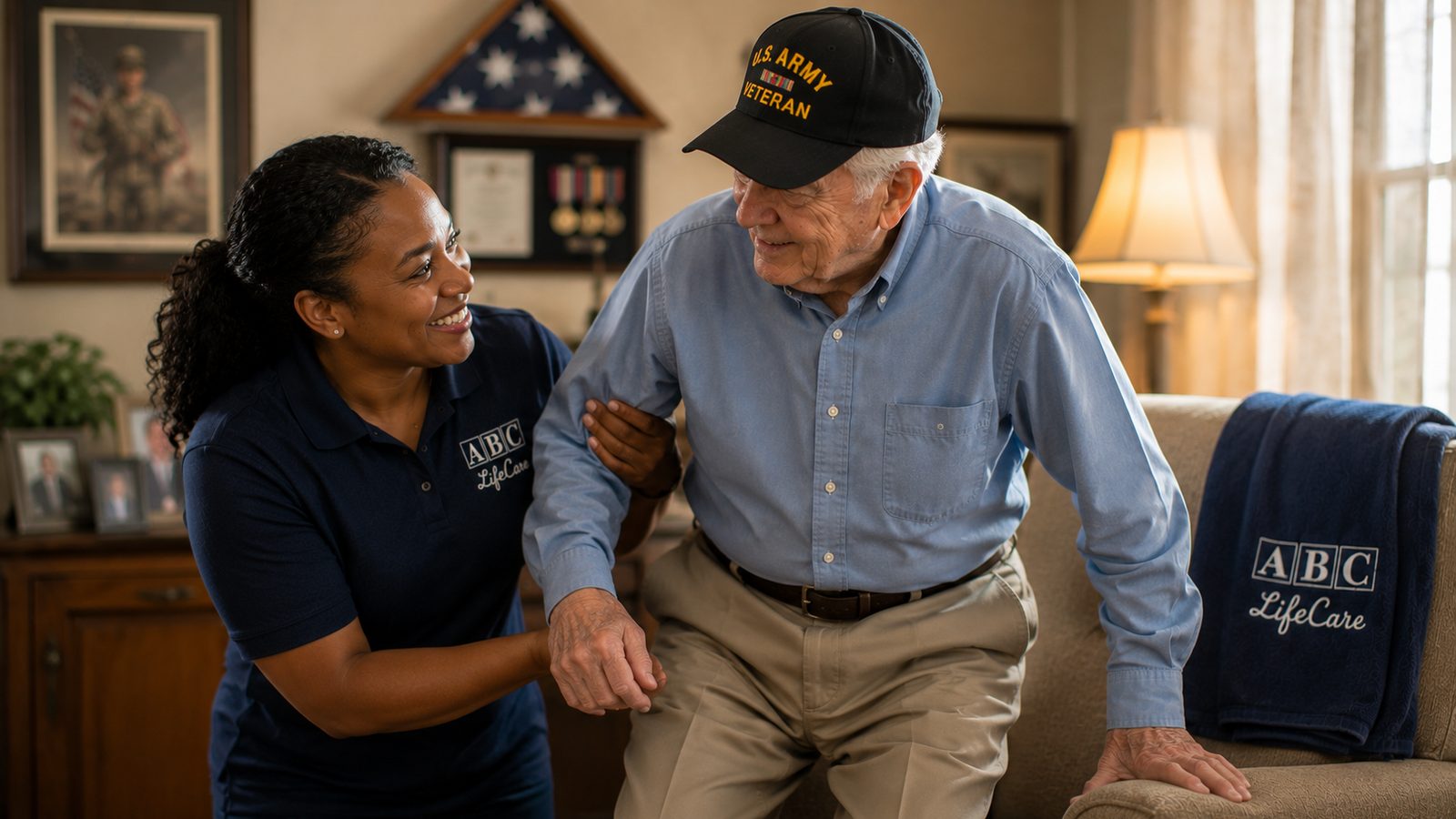
The VA Aid & Attendance (A&A) allowance is one of the most under-used benefits in Veteran care. It can pay $1,500–$2,800+ per month toward in-home care, and it’s available not just to Veterans but also to their surviving spouses. If your Veteran (or your widowed parent) needs help at home, this is one of the first benefits to check.
What does Aid & Attendance actually pay for?
A&A isn’t paid directly to a care agency — it’s paid to the Veteran (or spouse) as a monthly cash payment. The Veteran then uses that money to pay for home care services from any qualified provider. As of 2026, monthly maximums are roughly:
- Single Veteran with A&A: ~$2,358/month
- Married Veteran with A&A: ~$2,795/month
- Surviving spouse with A&A: ~$1,515/month
- Two married Veterans, both with A&A: ~$3,740/month
These amounts are reduced by any “countable income” the household has — but unreimbursed medical expenses (including home care costs) reduce countable income, often quite significantly.
Eligibility: the three tests
1. Veteran service requirement
The Veteran must have:
- Served at least 90 days of active duty, with at least one day during a recognized wartime period (WWII, Korea, Vietnam, Gulf War, post-9/11 era)
- Been honorably discharged
You don’t have to have served in combat — just during a wartime period. Even basic-training-era service counts if the dates align.
2. Income and asset limits
The VA uses a measure called the “Net Worth Limit.” In 2026, the limit is approximately $159,240, which includes most assets except your primary residence, one vehicle, and personal effects. Income above that gets “rolled into” net worth via a 3-year look-back.
Important nuance: Medical expenses — including out-of-pocket home care — reduce your countable income. This means many people who think they don’t qualify actually do once their care costs are factored in.
3. Need for assistance
You must need help with at least one of:
- Bathing, dressing, or eating
- Transferring (e.g., bed to chair)
- Toileting / continence care
- Adjusting prosthetics or medical devices
- Protection from hazards in your environment
OR you must be:
- A nursing home resident, OR
- Bedridden, OR
- Legally blind, OR
- Substantially confined to your home due to disability
How to apply
- Get the right form. Veterans use VA Form 21P-527EZ. Surviving spouses use VA Form 21P-534EZ.
- Gather documentation. DD-214 (discharge papers), marriage certificate if applying as a spouse, bank statements, monthly bills, medical evidence of need, and physician statement.
- Document your medical expenses. Have receipts and a statement of expected ongoing home care costs. This is what offsets your income.
- File the application. Online via VA.gov, by mail, or in person at a VA regional office.
- Wait. Decisions take 3-6 months on average. Benefits, when approved, are retroactive to the application date.
Common mistakes
- Assuming you don’t qualify because of the asset limit. The medical-expense offset is powerful. Apply if there’s any chance.
- Gifting assets to get under the limit. The 3-year look-back will catch this and create a penalty period. Talk to a VA-accredited attorney before transferring assets.
- Paying a “benefits planner” up front. It’s illegal under VA rules for anyone to charge a fee to prepare or file your A&A application. Free help is available from VSOs (VFW, American Legion, DAV) and VA-accredited attorneys.
What about Veteran-Directed Care (VDC)?
Separate from A&A is a VA program called Veteran-Directed Care, where the VA pays the care provider directly. This can be a better fit than A&A in some cases, especially when the Veteran needs a higher level of care than A&A can support. We help Veterans evaluate both paths.
This article is educational and not legal advice. VA rules change. Always verify current rules with a VA-accredited representative or the VA directly. Numbers above are as of June 2026.